Home
comundos

Main navigation

  • Workshops
  • Podcasts
  • Videos
  • Lessons
    • SDG lesson plans
  • News
  • About us
Gebruikersmenu
  • Donate
  • Log in

Breadcrumb

  1. Home

SDG10: Reduced Inequalities Within and Among Countries

By the end of this lesson, the student will be able to:
1. Understand what SDG10 advocates for.
2. Distinguish between inequalities within and among countries.
3. Understand the difference between overt and covert racism.
4. Analyze digital stories on SDG10 on topics like inclusion and immigration.
5. Reflect on the concept of “diversity” in oneself and others by watching a video about diversity.
 

BACK TO INTRO

SDG
10. Reduced inequalities
SDG act
10: REDUCED INEQUALITIES
Pedagogical twist

For the SDG 10 (reduced inequalities) sheet, our favorite pedagogical twist is: Reflection Assignment: At the end of a lesson cycle, assign students to create a reflection piece about SDG10. Students can record their learning, generate final thoughts, ask questions, or think about how they would approach work differently in the future. It's valuable to hear what parts of a unit stood out and why, and what parts were less meaningful and why. This reflection assignment can be used as a reflection instrument and for peer assessment. In this case, students are divided into groups of about six students, and each student reports their reflection assignment that will be assessed by their peers in the group through feedback and a final score. Teachers should provide students with clarified goals and criteria for assessment. Scores are not the final scores for the teachers but help them in the final assessment process while students learn how to evaluate other fellow students. If you have another pedagogical twist in mind, feel free to apply or check the pedagogical twists list.

Activiteit
Activity 1: Brainstorming

Brainstorm session based on the following suggested questions. 
• Are we all the same?
• Are we all treated in the same way? 
• Which vulnerable groups does SDG10 aim to protect?
• Income disparities are inequalities to be reduced WITHIN countries. Do you know another example?
• Disparities in representation and voice for developing countries in decision-making in global economics are existing inequalities AMONG countries. Do you know another example?
• Are all forms of racism visible?
• Police brutality against people of color (POC) is one of the multiple socially acceptable and invisible manifestations of racism. Do you know other examples?   
• What is the difference between a migrant and a refugee?
Possible adaptations: (Online) This activity can be done with the use of online tools such as Jamboard, Mentimeter, or Miro.

1 Note for teachers: more information on inequalities within countries can be found here.

Introducing the topic of reduced inequalities

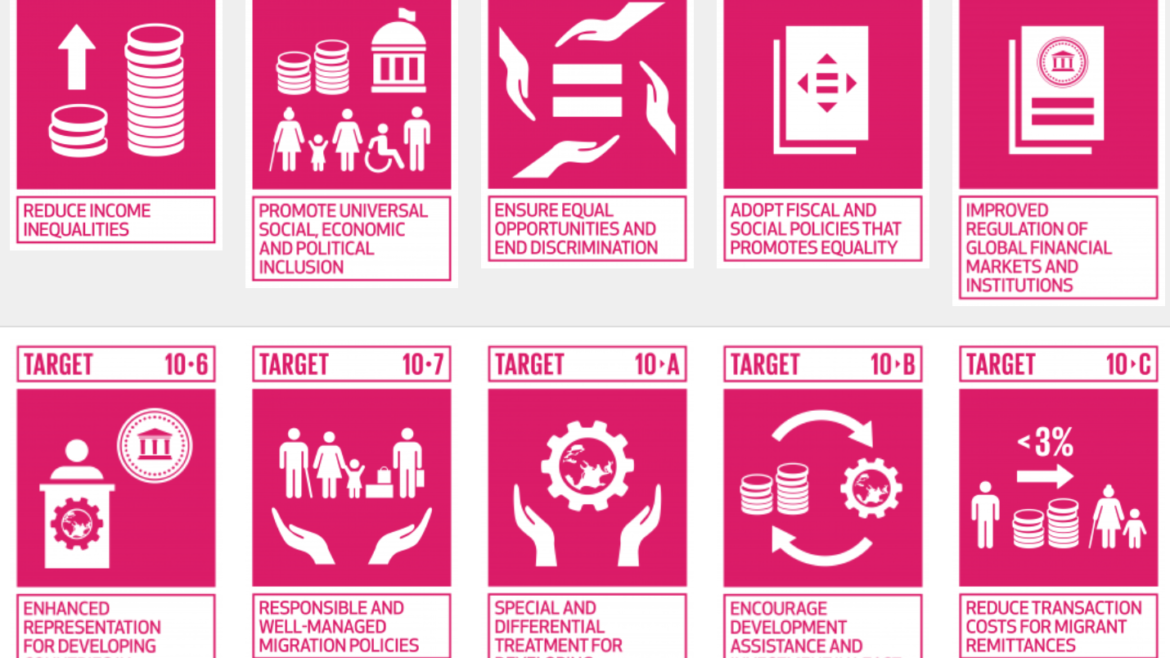
SDG 10 addresses inequalities within and among countries. It calls for nations to reduce inequalities in income as well as those based on age, sex, disability, race, ethnicity, origin, religion, or economic or other status within a country.

In fact, just 8 men own the same wealth as half of the world. The gap between rich and poor remains quite wide. However, according to the UN, before Covid-19, income inequality was falling in some countries. Unfortunately, the pandemic can lead to a reversion of such progress (as reported in the UN_Report2021).
The most vulnerable groups (older people, immigrants, refugees, people with disabilities, children, LGBTQ+ community members, and women) face high inequalities. Moreover, often these groups intersect (i.e., a refugee woman with a disability), and inequalities strengthen. 
To reduce inequalities, many changes must be made at policy levels.

Activity 2: Digital Stories

Watch the digital stories and answer the subsequent questions. This activity can be done individually or in groups of 3-4 students.

1. Rights and freedom

What message does the author want to send?
What type of discrimination is the protagonist experiencing?
Are students of different religions treated equally in your school?
Which initiative in your school could raise awareness of racism?
2. Illegal_emigration

What message does the author want to send?
Where does the protagonist get imprisoned?
Do you know what is going on in Libya?
What factors define whether it is legal or illegal emigration?
How would you feel if, in order to have a better quality of life, you were forced to move to another country?
Does your country have a comprehensive set of migration policies?

Activity 3: We are all different, and that's awesome!

Let students watch this video (in class or at home individually) (We Are All Different—and THAT'S AWESOME! | Cole Blakeway) and start a discussion with the students, following the suggested questions:

Are you different from others? How? Your personality? Your appearance? Your hobbies? Etc.
Do you regard your diversity as a positive or a negative feature? Why?
What are the benefits of a world full of diversity, where everyone accepts and equally respects one another?
What is the final message the young speaker wants to send in the video?

Activity 4: Quiz

This quiz is about UN Goal 10: Reduced Inequalities Within and Among Countries. You can either use it at the end of your lesson to revise the topics you have already talked about or at the beginning of the lesson to challenge students' prior knowledge and gain their attention.

Pedagogical twist: 

For the SDG 10 (reduced inequalities) sheet, our favorite pedagogical twist is: Reflection Assignment: At the end of a lesson cycle, assign students to create a reflection piece about SDG10. Students can record their learning, generate final thoughts, ask questions, or think about how they would approach work differently in the future. It's valuable to hear what parts of a unit stood out and why, and what parts were less meaningful and why. This reflection assignment can be used as a reflection instrument and for peer assessment. In this case, students are divided into groups of about six students, and each student reports their reflection assignment that will be assessed by their peers in the group through feedback and a final score. Teachers should provide students with clarified goals and criteria for assessment. Scores are not the final scores for the teachers but help them in the final assessment process while students learn how to evaluate other fellow students. If you have another pedagogical twist in mind, feel free to apply or check the pedagogical twists list.

Facebook Instagram Spotify YouTube

Language switcher

  • English, British
  • Dutch
  • French
  • Portuguese, Brazil
  • Spanish

Support online courses


Subscribe to our mailing list

 
Logo Comundos

Facebook
Instagram
Youtube
Spotify
LinkedIn


Support Comundos

Powered by Drupal